Consulting services

What Ingressible offers.

Four services, one thread: preserving what makes a beauty experience distinct while expanding who can meaningfully participate. We work with retailers, boutiques, fragrance and makeup brands. Your mission and what customers should be able to do, understand and feel guide the assessment. We help establish the goals and recommend practical improvements for disabled customers and anyone unintentionally left out.

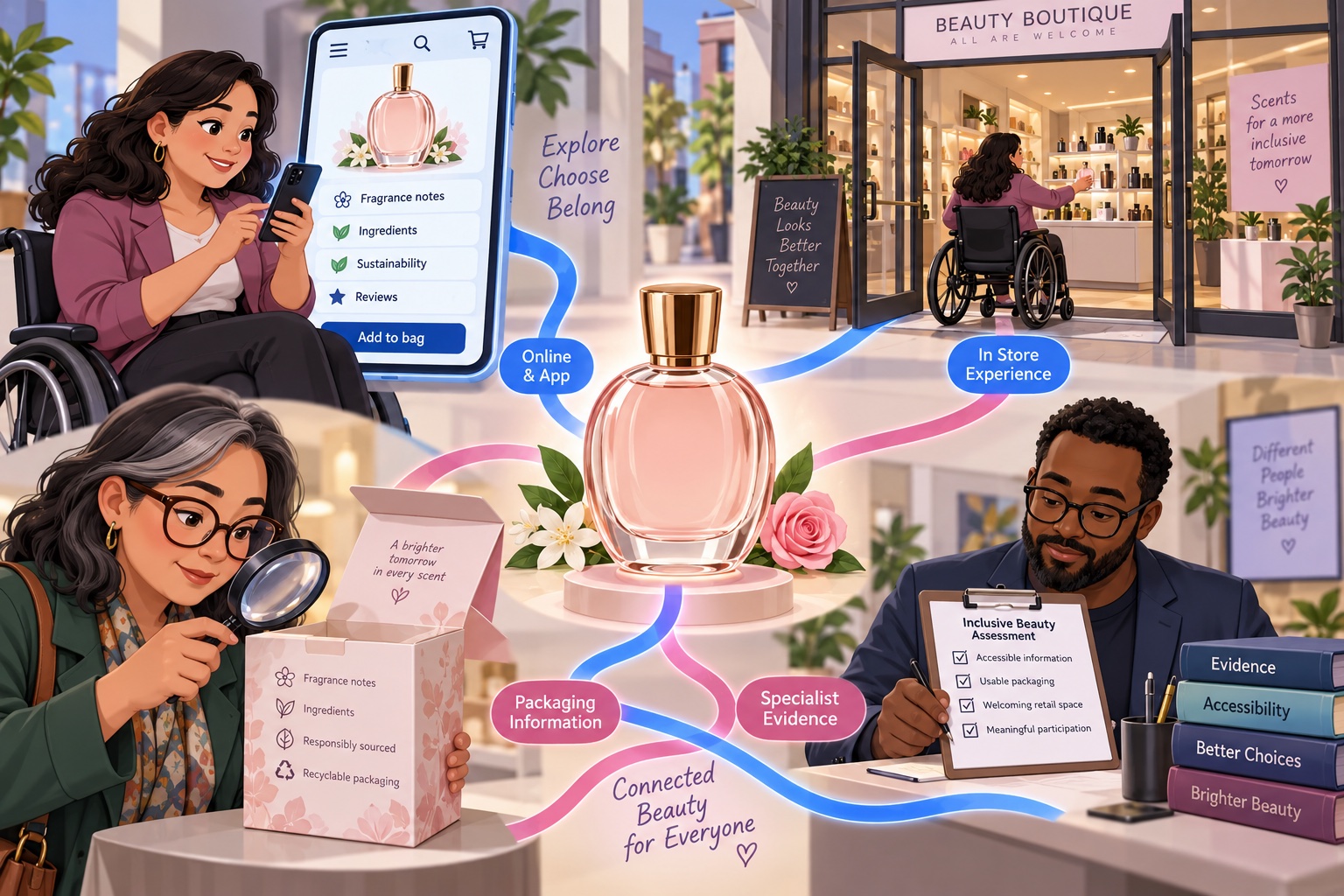
Cartoon concept connecting digital shopping, in-store experience, packaging information and specialist evidence around a perfume bottle. A wheelchair user explores the product on a phone and enters a boutique. A low-vision shopper uses a magnifier to read packaging. A specialist reviews a fictional checklist. The blue and pink paths show how the experiences connect; these are illustrative scenes, not client findings.
One product, a connected experience. A bottle connects to packaging, a phone, a shop and a checklist. The connections show that product access depends on the whole shopping and use experience. Our four services assess website and app journeys, retail experiences including mystery shopping, and fragrance and makeup products. We document barriers and recommend practical improvements; retesting is agreed in scope.

01, AssessmentWebsite & App Accessibility and Customer Journey Assessment
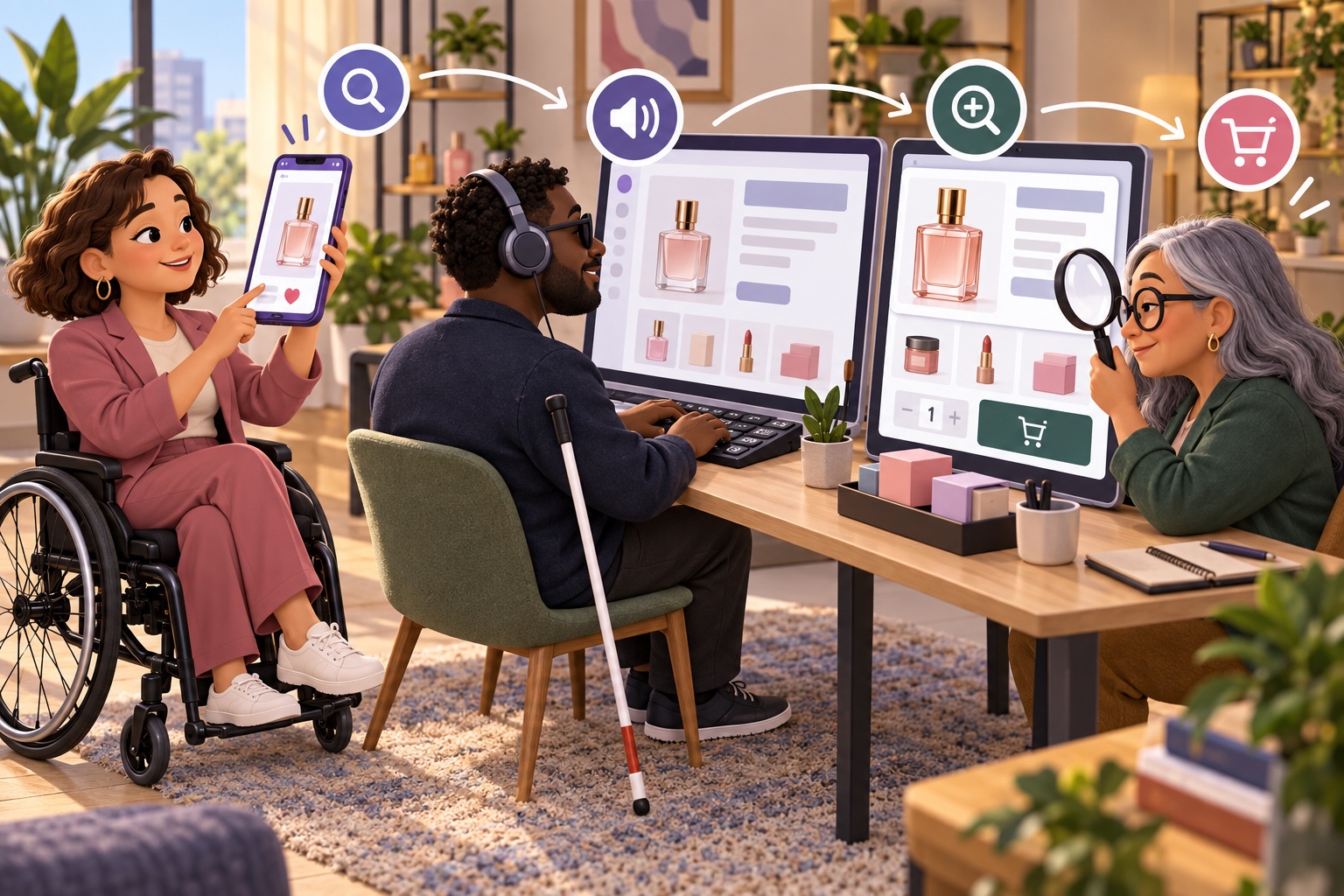
Cartoon beauty-shopping journey: a wheelchair user discovers a perfume on a phone; a blind shopper uses a keyboard and headphones for screen-reader access, with a white cane beside the desk; a low-vision shopper uses magnification while reviewing products and cart quantity. Arrows connect discovery, audio access, magnification and purchase. The adjacent text defines the agreed assessment tasks.
  • Product discovery
  • Product information
  • Navigation
  • Forms
  • Cart & checkout
  • Desktop & mobile web
  • iOS & Android apps
  • Keyboard & assistive technology
  • Prioritized recommendations
  • Agreed retesting

Find barriers in product discovery, navigation, forms, cart and checkout on websites and agreed iOS or Android apps. Give your team evidence and prioritized recommendations.

We agree website pages or app screens, platforms, device versions, shopping tasks, secure test access, methods and relevant accessibility guidance before testing. Recommendations help your team make improvements while preserving the visual identity and experience you intended.

Tasks and deliverables

Test agreed discovery, product decisions, forms, accounts, cart editing and checkout tasks. Examine keyboard and screen-reader operation, focus, text enlargement, reflow, contrast, touch controls, status messages and error recovery. Client digital assessments target WCAG 2.2 AA within the agreed scope; native apps use relevant platform checks and applicable WCAG2ICT guidance.

Receive a tested-coverage record, task findings with evidence and recommendations, annotated screenshots or agreed recordings, and a prioritized improvement plan. Your proposal confirms the selected journeys, testing environments, evidence, discussion and any separately agreed support or recheck. A limited sample does not establish whole-site or whole-app conformance.
02, AssessmentRetail Experience Assessment

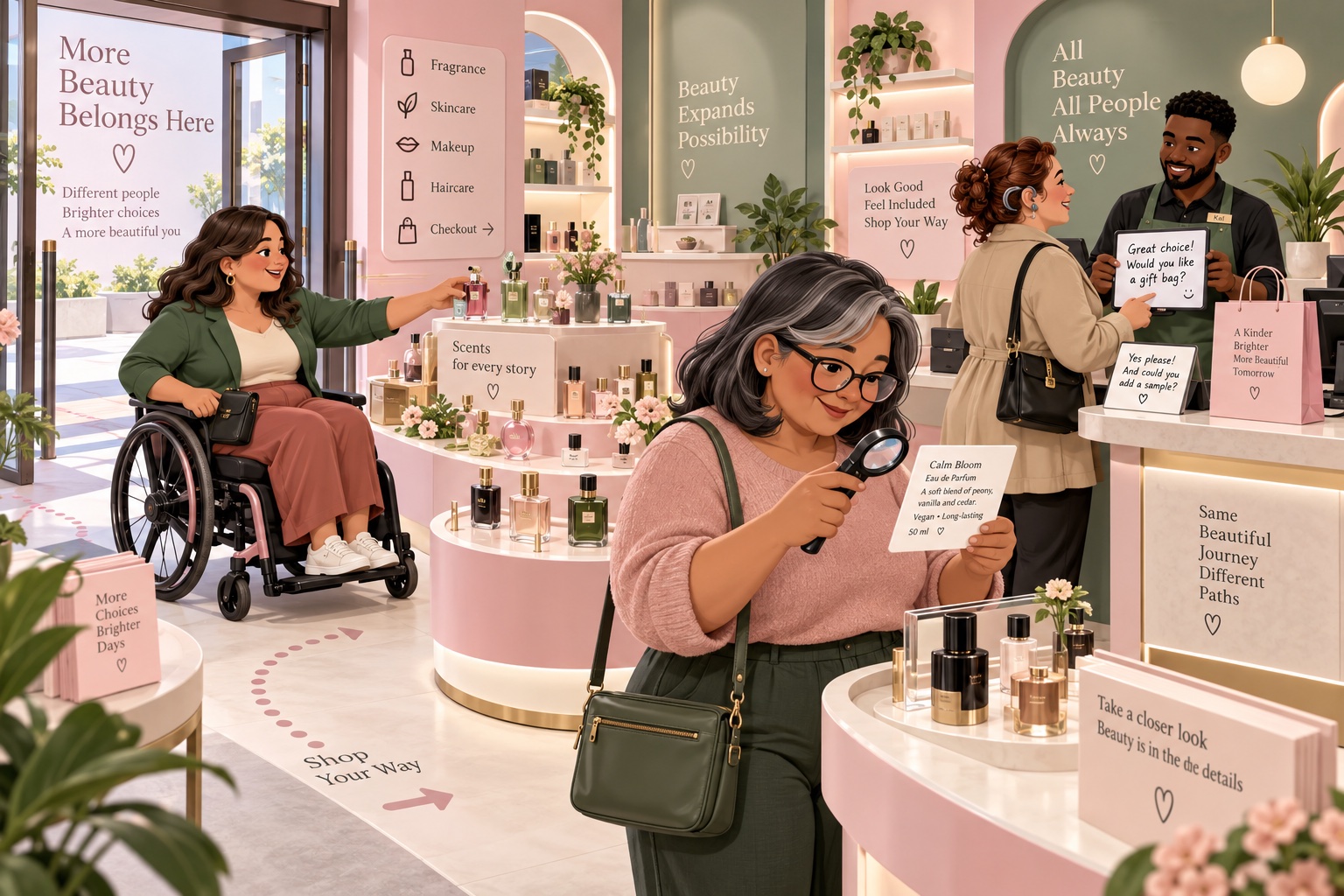
Cartoon boutique journey: a wheelchair user reaches a perfume display; a low-vision shopper reads product information with a magnifier; a deaf shopper and a store colleague exchange written messages at checkout. A pink route connects arrival, product finding, information and assistance. This fictional store illustrates different ways to participate; it is not a surveyed location or a compliance certification.
  • Store navigation
  • Displays
  • Product information
  • Testers & sampling
  • Customer service
  • Checkout
  • Agreed store locations
  • Mystery shopping

Assess store navigation, displays, product information, testers, customer service and checkout through specialist walkthroughs and mystery shopping, so more people can take part in your retail experience.

Your goals determine the shopping tasks. We examine what supports participation and where potential disability barriers arise, then recommend practical improvements that preserve your store’s atmosphere and identity. Physical product testing is separately scoped.

Tasks and deliverables

Follow agreed arrival, orientation, product-finding, information, sampling, demonstration, assistance and purchase tasks. For Brand Discovery & Accessibility Mystery Shopping, agree one NYC or Connecticut stockist, your goals, scenario and purchase arrangements. The visit is unannounced, with no photographs, audio, video, screenshots, visible testing notes or testing equipment. Observations are written privately after leaving, with recalled dialogue identified as recollection. The private report and 45-minute discussion address your questions; one visit describes one encounter. Ingressible retains the purchased fragrance. An announced assessment permits direct investigation and agreed documentation.

Receive a visit and task coverage record, documented observations, prioritized recommendations and an action plan. Your proposal confirms the location, visit approach, customer goals, documentation and any separately agreed support or recheck. A specialist visit records observed conditions; it is not a representative customer survey or building-code certification.

03, AssessmentFragrance & Makeup Product Accessibility Testing

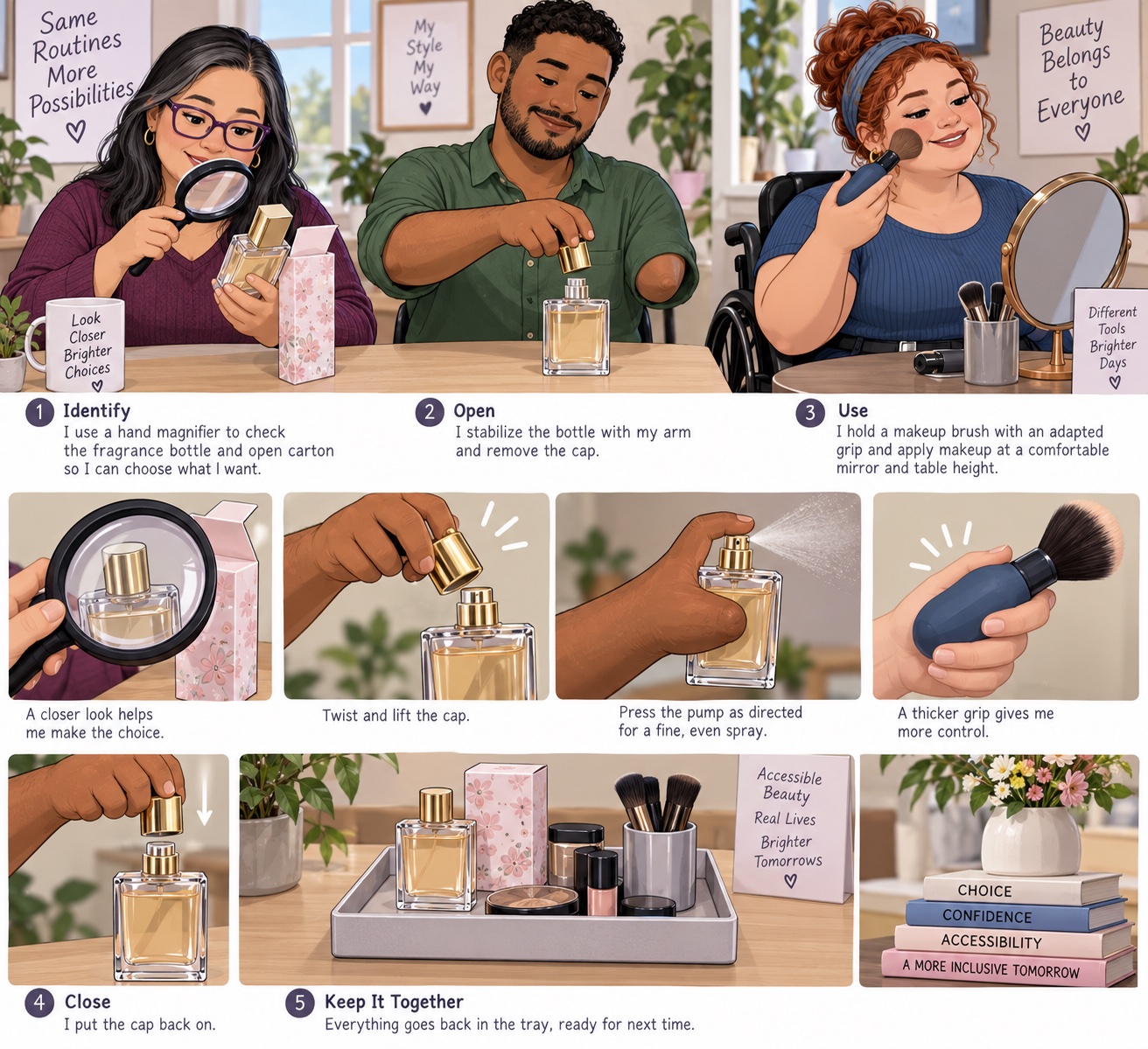
Cartoon product-use concept with five stages: identify, open, use, close and keep together. A low-vision person identifies a fragrance using a magnifier. A person with a limb difference removes a bottle cap. A wheelchair user applies makeup with an adapted brush grip. Insets show cap removal, spray control, thicker grip, recapping and organized storage. These are illustrative tasks; actual use follows the manufacturer directions and agreed testing scope.
  • Fragrance & makeup
  • Identification
  • Instructions
  • Opening & closures
  • Grip & handling
  • Dispensing
  • Application
  • Everyday use
  • Agreed samples & prototypes

Send agreed samples or prototypes for hands-on testing of identification, instructions, opening, handling, dispensing, product-specific application, correction, removal, cleanup, storage and agreed refill tasks. Professional accessibility testing, not promotional reviews.

Packaging is part of how people use the product. We agree sample handling and scope before shipping; this work assesses usability and accessibility and does not promise product safety certification or influencer coverage.

Fragrance & makeup product testing

Product-specific routines

Agree the products, formats and customer tasks before testing. Fragrance and makeup are distinct services, presented together here because they share a product-accessibility approach. Each has its own scope and product-specific routine, guided by what you want customers to do, understand and experience.

Fragrance: from discovery to returning

  1. Choose and understand.

    Review the available scent description, notes, concentration, size, format, use directions and relevant manufacturer warnings. Assess whether customers can distinguish the options using the information provided.

  2. Identify and organize.

    Distinguish similar bottles, scents, concentrations and sizes using accessible labels, physical differences and product information.

  3. Open the outer packaging.

    Locate seals, tabs and opening directions; open the carton and remove the bottle or sample without an unintended spill.

  4. Remove and replace the closure.

    Test the cap, screw closure or agreed stopper; record grip changes, two-handed actions, assistance and closure alignment.

  5. Hold and orient.

    Assess stable grip, reach and the feedback available for finding the outlet and understanding its direction.

  6. Sample and compare.

    Follow the agreed blotter or sample routine, identify which sample is which and access the information needed to compare or return to a choice.

  7. Operate and control dispensing.

    Use the spray pump, atomizer, roller or agreed vial; record attempts, control of quantity, unintended release, leaks and spills.

  8. Apply and recover.

    Follow the manufacturer’s intended use directions under agreed conditions; record positioning, assistance and recovery after an unsuccessful task.

  9. Refill and reassemble.

    For a refillable format, follow its instructions to open, align, transfer, control the amount, reconnect and close. Refilling is included only for agreed compatible products.

  10. Store, travel and return.

    Close, store, carry and identify the product again; assess agreed care, refill and repeat-purchase information. Ordinary use observations are not laboratory leak or transport certification.

Formats we can assess

  1. Full-size spray bottles.

    Outer packaging, bottle removal, cap, stable grip, nozzle orientation, pump operation, quantity control and recapping.

  2. Travel sprays and atomizers.

    Unlocking or cap removal, small-part identification, orientation, grip, dispensing, relocking and agreed carrying tasks.

  3. Spray sample vials.

    Label identification, small cap, outlet direction, handling the small format, spray attempts and closure.

  4. Dab or splash vials.

    Stopper or screw closure, grip, controlled opening and manufacturer-directed transfer or application, then closing and cleanup.

  5. Rollerballs.

    Unscrew, hold and orient, make the instructed rolling contact, check control and recap.

  6. Refill systems.

    Identify compatible products, follow instructions, align and transfer, control fill quantity, reassemble and check the agreed task.

  7. Discovery and gift sets.

    Open the set, distinguish components and variants, match each item to its information, sample without mixing identities and store again.

Makeup: the complete routine

  1. Choosing the product.

    Review coverage, finish, texture, format, application method, required tools, intended use, shade and undertone.

  2. Learning the routine.

    Review instructions and tutorials for sequence, quantities, placement, blending, correction and alternatives to visual-only demonstrations.

  3. Identifying and organizing.

    Distinguish similar products, shades and applicators using labels, physical differences and accessible information.

  4. Opening and preparing.

    Test seals, catches, caps, twists and pumps; record grip changes, two-handed actions and assistance.

  5. Controlling the amount.

    Dispense, load the applicator and remove excess; record unintended release, spills and waste.

  6. Positioning and applying.

    Assess reach, grip, stability, orientation, precision and repeated movements using agreed personal tools.

  7. Blending and building.

    Spread, blend and layer the product; examine the feedback available for deciding when to stop.

  8. Checking the result.

    Examine how missed areas, excess, uneven application or marks can be detected; record assistance used.

  9. Correcting mistakes.

    Reposition, remove excess, clean a mark or restart the agreed task.

  10. Wear and touch-ups.

    Record agreed everyday observations, maintenance and reapplication effort; do not make validated laboratory or clinical wear claims.

  11. Removal and cleanup.

    Follow the instructed removal sequence and assess tools, containers and cleaning materials.

  12. Closing and returning.

    Close, store and find the product again; review care and repeat-purchase information.

Product-specific tasks

  1. Foundation and concealer.

    Unlock, dispense, control quantity, load, apply, reach, blend, build, check, correct and remove.

  2. Pressed and loose powder.

    Open the compact or sifter, load and unload the puff or brush, control spills, apply, close and clean up.

  3. Blush, bronzer and highlighter.

    Distinguish products, control pickup, place, blend, build intensity and correct.

  4. Lipstick.

    Remove the cap, extend and retract, orient and stabilize, apply, correct and recap without damaging the product.

  5. Gloss and liquid lip products.

    Grip the tube, withdraw and orient the applicator, control excess, place, return and close.

  6. Mascara.

    Grip, withdraw, control excess, position and move the wand, return and close under an agreed eye-area protocol.

  7. Eyeliner and brow products.

    Identify, sharpen or extend where applicable, load, orient, control, correct and recap.

  8. Eyeshadow and palettes.

    Open, identify pans and information, load and control pickup or fallout, place, blend, clean and close.

Evidence and deliverables

Record completion under documented conditions, attempts, grip changes, assistance, dispensing or application errors, spills, tools and instructions, and agreed time, effort or discomfort observations. Findings are specialist observations, not a universal disability score.

  • Product and routine coverage record.
  • Task findings register.
  • Annotated product and applicator images.
  • Instructions and tutorial findings.
  • Improvement brief separating packaging, applicator, information and service recommendations.
  • Revision-checking protocol.

Your proposal confirms coverage and file formats. Your proposal confirms the product, routine, methods, evidence and any separately agreed support or recheck.

Eye-area tasks follow an agreed hygiene and safe-use protocol. Fragrance tasks follow manufacturer directions; sensitivity, ingredient and safety questions require appropriate manufacturer or qualified advice. This work does not provide clinical testing, safety certification or a recruited customer panel.

Research informing the tasks

Reviewed 4 October 2026. Research guides what we investigate; it does not establish Ingressible’s results or a brand’s revenue.

  • FDA: Fragrances in Cosmetics. Manufacturer directions and product information guide agreed use tasks. Sensitivity, safety and ingredient questions require appropriate manufacturer or qualified advice; this service does not certify hypoallergenicity or safety.
  • CHI 2022: It Feels Like Taking a Gamble. Qualitative research using 145 videos and interviews with 12 visually impaired participants; supports investigating learning, feedback and physical barriers, not universal prevalence or Ingressible outcomes.
  • FDA: Eye Cosmetic Safety. Eye-area testing requires an agreed hygiene and safe-use protocol. Accessibility testing is not safety certification.
  • ISO 17480: Accessible design, Ease of opening. Public abstract reviewed; access to the complete standard and an agreed method are needed before claiming assessment against its full requirements.

One mission. Four services.

What does inclusion make possible?

We investigate access, capability and belonging in the moments that matter to your customers. The questions change with the experience; the care behind them stays the same.

Website & checkout

AccessAccess: Can people discover products, perceive information and find their way through the site?

CapabilityCapability: Can they compare, complete forms and use the cart and checkout with different ways of interacting?

BelongingBelonging: Are choice, support and error recovery designed with different customers in mind?

Retail experience

AccessAccess: Can people find the store, navigate displays and access product information?

CapabilityCapability: Can they sample, ask for help, make choices and complete their purchase?

BelongingBelonging: Does the service consider different needs without taking away customer choice?

Fragrance & makeup

AccessAccess: Can people identify the product, variant and use information?

CapabilityCapability: Can they open, grip, dispense and apply the agreed product?

BelongingBelonging: Can more people take part in the brand experience while its character is preserved?

The rows group digital, retail and product experiences; fragrance and makeup each have a distinct assessment scope. Read each column as a question about access, capability or belonging. Together, the questions connect finding an experience with using it and feeling considered. We use them to guide testing and recommendations. Findings depend on the agreed pages, locations, samples and methods.

How engagements work

One clear process across all four services.

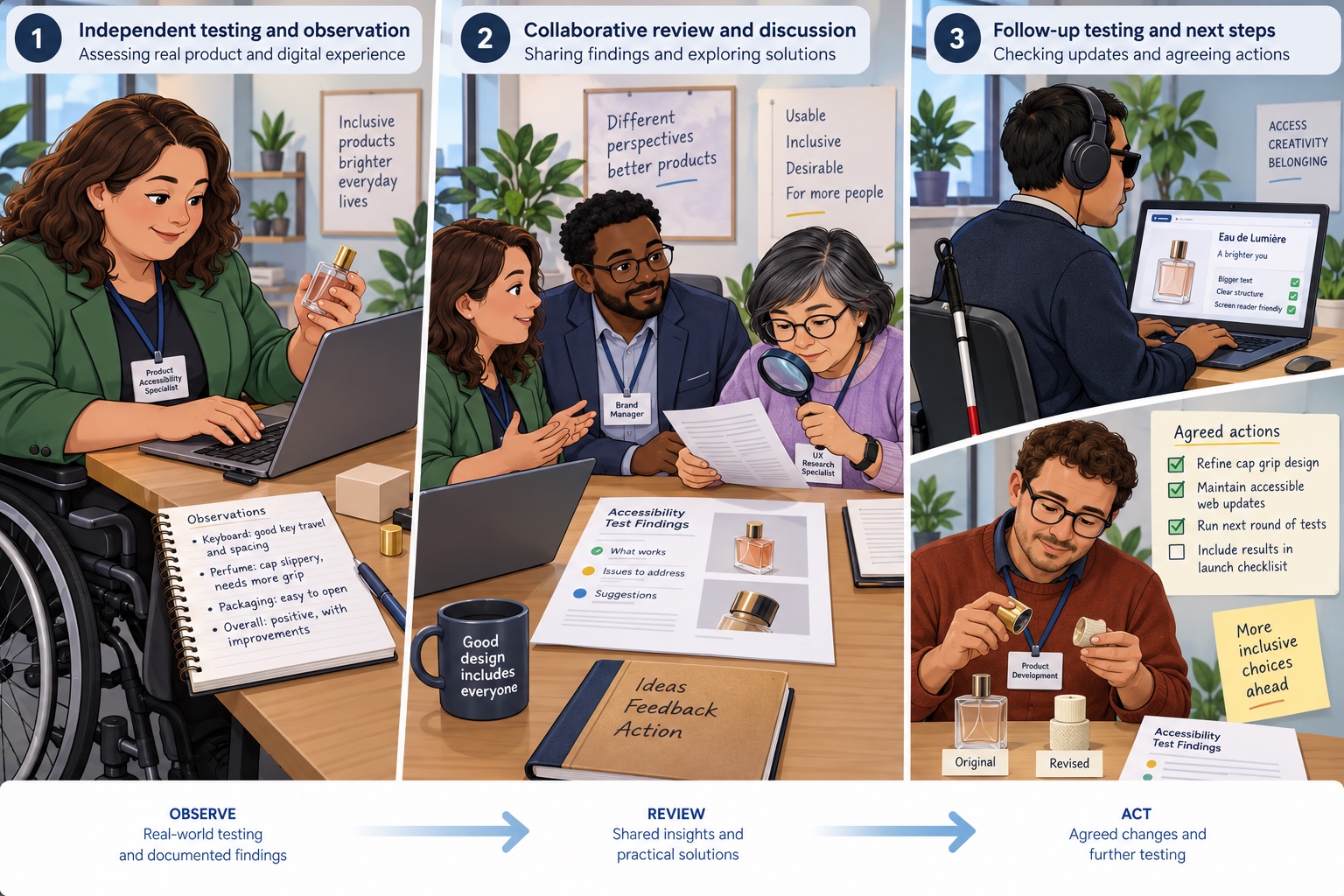
Cartoon concept with three labeled stages: independent testing and observation; collaborative review and discussion; follow-up testing and next steps. A wheelchair-using specialist examines a laptop and perfume. Colleagues review observations with a magnifier. A blind specialist uses a keyboard and headphones, and another person compares original and revised closures. The illustrated findings and actions are fictional; the adjacent text explains the agreed process.

Assessments

A defined scope, clear methods, findings that stand independently, and recommendations that respect your brand's intention.

Review recommendations

Review the evidence, priorities and practical recommendations with your team before deciding what to change.

Agree follow-up testing

Retesting can be included in an agreed assessment scope to check your team’s updates against the original findings.

Professional boundaries

Assessments use professional testing, measurement, and simulation methods. Ingressible does not position digital certifications or simulations as proof of expertise in physical product design, and does not publish confidential client findings. Illustrative samples are always labeled as such.

Getting started

Start with a conversation. Ingressible will scope the work, define methods and limitations up front, and only report what evidence can support.

Start a Consultation

Illustrative work

Explore sample assessment formats.

These samples demonstrate report structure and writing style. They are illustrative, not client work, certifications, or findings about a live product.

Services shaped around your intended experience.

Choose the services that reflect what you want customers to encounter, understand and do. We agree the goals, coverage and deliverables with you. Services can be combined in one proposal, with each assessment’s boundaries kept clear.

Across every service, we examine access, participation and potential disability-related barriers while preserving your business’s identity. You receive documented observations, professional insight and practical recommendations.

Website & mobile experience

Assess three agreed customer journeys using the specified desktop and mobile-browser environments. Installed-app assessments have separate platform, version and journey coverage. Digital checks use applicable WCAG 2.2 criteria.

Choose the journeys
Three agreed customer journeys, with clear start and end points.
Agree the environments
Specified desktop and mobile-browser coverage; installed apps assessed separately.
Investigate barriers
Relevant WCAG 2.2 checks, observations and professional interpretation.

From intention to practical action

We begin with what your business wants customers to do, understand and feel. Your assessment examines the agreed experience through accessibility expertise and potential disability-related barriers.

Receive documented observations, professional insight and prioritised recommendations that preserve your identity. Exact evidence, deliverables and discussion are agreed in your proposal.

Preserve the Vision. Expand the Experience.

In-store customer journey

Explore the agreed shopping journey from discovery through an authorised purchase, including information, sampling access and assistance. Choose an announced assessment or separately agreed discreet mystery shopping.

Follow the shopping journey
Discovery, information, sampling access and assistance through an authorised purchase.
Agree the visit
Named location and announced assessment or discreet mystery-shopping approach.
Respect customer choice
Examine potential barriers to access and participation without assuming an individual’s lived experience.

From intention to practical action

We begin with what your business wants customers to do, understand and feel. Your assessment examines the agreed experience through accessibility expertise and potential disability-related barriers.

Receive documented observations, professional insight and prioritised recommendations that preserve your identity. Exact evidence, deliverables and discussion are agreed in your proposal.

Preserve the Vision. Expand the Experience.

Fragrance product accessibility

Examine the agreed fragrance format and intended routine, including information, identification, packaging, handling and use. Product variants, methods and any optional equipment sessions are confirmed before testing.

Define the routine
An agreed fragrance format, packaging version and intended use.
Examine interactions
Identification, information, opening, handling and dispensing as relevant to the product.
Record the conditions
Methods and any optional equipment sessions agreed and documented separately.

From intention to practical action

We begin with what your business wants customers to do, understand and feel. Your assessment examines the agreed experience through accessibility expertise and potential disability-related barriers.

Receive documented observations, professional insight and prioritised recommendations that preserve your identity. Exact evidence, deliverables and discussion are agreed in your proposal.

Preserve the Vision. Expand the Experience.

Makeup product accessibility

Examine the agreed beauty product, packaging and applicator through its intended routine. Tasks reflect the format, customer goal and potential accessibility barriers, with application boundaries agreed in advance.

Choose the product
An agreed beauty format, variant, packaging and applicator.
Follow its intended use
Tasks tailored to accessing information, handling and using that product.
Set clear boundaries
Application, included tools and testing conditions agreed before work begins.

From intention to practical action

We begin with what your business wants customers to do, understand and feel. Your assessment examines the agreed experience through accessibility expertise and potential disability-related barriers.

Receive documented observations, professional insight and prioritised recommendations that preserve your identity. Exact evidence, deliverables and discussion are agreed in your proposal.

Preserve the Vision. Expand the Experience.

Preserve the Vision. Expand the Experience.

Your scope, agreed together.

A clear agreement connects your intentions to the experience we assess. You will know what we are exploring, how we will work and what you will receive before testing begins.

The experience

Your goals, selected services and the agreed products, locations or customer journeys. We identify what matters to preserve and the accessibility questions to investigate.

The assessment

Specific tasks, environments, methods, permissions and timing. Any additional products, visits, journeys or testing are agreed separately.

The findings

Agreed evidence, deliverables and discussion, with practical recommendations. Any support or recheck has explicit boundaries. Fees are shared privately.

Our approach. Physical assessments use Ingressible’s adapted POUR principles and beauty accessibility criteria. They do not establish WCAG conformance for a physical product or store.

One assessment, or continuing work. Begin with a defined assessment. Further services, implementation support or repeat assessments can be discussed with their own agreed coverage and terms.

Discuss the experience you want to offer

Which experience are you crafting?

A website shopping journey, a retail experience, a fragrance or makeup product, the conversation begins with your vision.