Website and App Accessibility and Customer Journey Assessment
From discovery to checkout and support, across agreed websites and iOS or Android apps.
Read the digital experiences guide →The Ingressible Assessment
You have created a brand worth discovering. Can people find it, choose confidently and enjoy what you have made?
Our founder-led accessibility and customer-experience assessment follows the moments that matter: exploring your website or app, shopping in your store, or identifying, opening and using your fragrance and makeup. We agree the focus around your brand, then test the experience with care.
Our lens brings beauty, practical accessibility testing and respect for your brand’s signature together. You receive documented barriers, clear priorities and recommendations your team can act on, so your investment has a defined purpose and a next step.
The right to access.The capability to participate.The opportunity to belong.
Keep the artistry. Make room for people.
The right to access. The capability to participate. The opportunity to belong.
Your vision. Their experience.
Find the product and information you need.
Compare, open, use and purchase with control.
Participate with dignity, as yourself.
Why beauty
It is not only the formula in a bottle. It is finding, identifying, understanding, opening, holding, dispensing, applying, purchasing, and returning to a product.
Beauty moves through packaging, product, digital touchpoints, retail environments, information, service, and emotion. That creates many opportunities for beautiful design. It also creates places where people can encounter barriers.
Ingressible looks across the entire experience, not just whether someone can technically reach it.
Every brand creates a little world: the curve of a bottle, a shade that catches the light, a fragrance that becomes a memory, the atmosphere of a beautifully imagined store. We begin with the artistry, intention and character that make that world yours.
Then we explore how more people might experience its magic. How someone discovers a scent, identifies a shade, opens a cherished bottle or moves through a shopping journey with confidence and choice.
Thoughtful inclusion makes room for human difference within the beauty you have created. Your signature stays recognizable. Your story finds new ways to reach people. More customers have the opportunity to feel considered, welcomed and part of the experience.
What clients can expect
Ingressible helps brands understand who their experiences may leave out and make thoughtful improvements while preserving their artistry, intention and character. This method explains the client experience and the practical steps behind our four services.
Can I find a way in? We follow the journey from reaching the website or entering the store to finding the intended item and its information.
In the illustration: The screen, bottle and magnifier show how product information helps a person find and identify the intended item.
Can I do what I came to do? We explore how people compare, choose, open, use and purchase with choice and control.
In the illustration: The phone and dispenser show two different kinds of control: completing a digital task and operating a physical product.
Was someone like me considered? We look for room to participate with dignity, as yourself, within the brand’s world.
In the illustration: A person is surrounded by conversation bubbles, showing that listening and responding help people feel considered.
Every brand creates a little world. We begin by understanding what makes yours recognizable, then explore how more people can discover, choose and enjoy it with confidence and control.
The right to access. The capability to participate. The opportunity to belong.
Four services · One connected experience
Websites and apps, retail spaces, fragrance and makeup. Each service has a clear testing method. Choose a guide to see the tasks, evidence and deliverables.
From discovery to checkout and support, across agreed websites and iOS or Android apps.
Read the digital experiences guide →From arrival to displays, service, checkout and returns, including agreed mystery shopping.
Read the retail experiences guide →From identifying and understanding a product to opening, handling, dispensing, applying, correcting, removing, cleaning up and returning to it.
Read the fragrance and makeup guide →Follow complete shopping tasks across the agreed desktop web, mobile web and native app surfaces. Record what was tested and which versions, states and access conditions were available.
Client digital assessments target WCAG 2.2 AA within agreed scope; additional AAA criteria are included when agreed. Ingressible’s own website and workspace target WCAG 2.2 AAA. Record results, exceptions, untested coverage and needed manual review. WCAG2ICT is informative guidance for non-web technology; it is not a separate certification. Do not make blanket app or website conformance claims from a limited sample.
Provide steps to reproduce, the affected journey and technology, relevant criteria, screenshots or recordings where authorized, user impact, priorities and practical remediation guidance. Recheck fixes and connected steps. Implementation is included only when explicitly scoped within demonstrated expertise.
Apply universal design principles to the tasks and recommendations. Review the requirements register for the relevant markets, service and product. Keep binding obligations, technical criteria and design recommendations distinct; refer unresolved regulatory or safety questions to qualified specialists.
Investigate the experience from planning a visit to leaving with the intended product or receiving help afterward. Look for both practical barriers and how people’s choices and dignity are respected.
Founder-led visits reflect the founder’s observations and disclosed testing perspective. Do not pretend to have a disability or describe simulation as another person’s lived experience. Disability-specific participant findings require actual, appropriately supported participants and a separately agreed research plan.
Map barriers to the journey, identify what already works and provide recommendations for retail operations, merchandising, service and staff training. Formal building-code interpretation requires a qualified built-environment specialist. Workshops use real findings and practical service scenarios; rechecks use the same agreed tasks.
Apply universal design principles to the tasks and recommendations. Review the requirements register for the relevant markets, service and product. Keep binding obligations, technical criteria and design recommendations distinct; refer unresolved regulatory or safety questions to qualified specialists.
Follow the agreed product-specific routine from identification and instructions to opening, handling, dispensing, application, correction, removal, cleanup, storage and refill tasks. Preserve the aesthetic intent while examining where information, packaging or interaction limits choice and control.
Check cap removal, nozzle orientation, spray control and bottle stability. Assess whether customers can obtain information and explore packaging without unwanted scent exposure. Record preference separately from accessibility. Smelling or wearing fragrance must remain optional.
Check shade identification and description, opening compacts and palettes, dispensing, applicator grip and positioning, useful spoken tutorial explanations and captions. Keep representation, general usability and accessibility findings distinct.
Use tools you can operate competently; record model, purpose, accuracy and limitations. Label simulation observations. Measure force or torque only with an appropriate instrument and a documented method. Product-contact testing requires agreed exposure, hygiene and stop procedures; packaging-only testing remains available.
Provide task observations, permitted photographs, measurements where justified, priorities and options for prototype changes. Evaluate an agreed revised sample before marking a finding resolved. Accessibility testing does not establish cosmetic safety, medical outcomes or allergy-safe claims; those require appropriately qualified review.
Apply universal design principles to the tasks and recommendations. Review the requirements register for the relevant markets, service and product. Keep binding obligations, technical criteria and design recommendations distinct; refer unresolved regulatory or safety questions to qualified specialists.
Required across all four services
Universal design and a documented legal applicability review belong in every assessment. Confirm the client’s markets, role and activities, then connect each relevant requirement to a source, an owner and evidence.
The expertise behind your assessment
Your assessment is led by Kechi Shellian Boniface, an accessibility expert with professional experience in enterprise, state and federal government environments. Her work brings together website and mobile testing, assistive technology, document accessibility, remediation guidance, training and accessibility leadership.
That experience helps turn requirements into decisions your team can use: what to examine, how to document a barrier, which improvements to prioritize and how to check the result. The work connects careful evidence with respect for your brand’s artistry and intention.
Professional certification
Certified Professional in Accessibility Core Competencies
Issued by the International Association of Accessibility Professionals. Awarded July 12, 2023.
Renewal due: August 4, 2026.
Renewal in progress.
Professional certification
Trusted Tester for Web on Windows
Issued by the U.S. Department of Homeland Security, Office of Accessible Systems & Technology. Awarded August 18, 2024.
Professional preparation for a structured approach to testing web accessibility.
View Trusted Tester certificate (PDF)Continuing professional development
Alison course certificate
Completed September 16, 2026, with CPD-approved learning hours recorded by Alison.
Foundational training in product-testing methods, evaluating findings and communicating results.
View product-testing learner recordThis is a starting reference library for the US, Great Britain and EU. Actual coverage is confirmed for each client. Other markets need their own review. Laws, technical standards and design guidance are recorded separately.
Across all four services, Ingressible’s beauty accessibility criteria use POUR: Perceivable, Operable, Understandable and Robust. We examine access to information, ability to act, clarity and reliable participation through relevant interactions or alternatives. Physical criteria adapt the principles to stores and products; they are not a physical WCAG certification. Universal design is a required design lens. Use it alongside the applicable laws and testing criteria to consider different abilities, preferences and ways of taking part. It is a design framework, not a legal certification or a promise that every need is covered.
Digital: equivalent access to checkout and support. Retail: dignified access to service and sampling. Products: identification and use that do not unnecessarily exclude or single people out.
Digital: alternative input methods. Retail: choice in information and assistance. Products: explore handedness, grip and optional ways to sample or use the item.
Digital: understandable navigation and errors. Retail: clear routes and service steps. Products: recognizable opening, orientation and dispensing instructions.
Digital: text alternatives and accessible status messages. Retail: usable signs and spoken information. Products: readable labels and supplementary tactile or accessible digital information.
Digital: review, correction and recovery. Retail: clear prices and recoverable purchasing steps. Products: examine accidental opening, dispensing and orientation errors without weakening safety features.
Digital: reduce unnecessary repeated input. Retail: consider fatigue, standing and reach. Products: examine grip, closure and pump effort using appropriate methods.
Digital: operable controls and reflow. Retail: space for different mobility needs. Products: consider hand size, grasp, stability and space for assistance.
Record the relevant principle, observed barrier, brand intention and recommended change. Validate the change through the original task. Do not replace individual adjustments or lived-experience research with a design checklist.
This is a starting reference library, not an exhaustive legal opinion. Confirm the client’s markets, legal role, customer groups, product classification, state and local jurisdictions before deciding applicability. Record relevant requirements or obtain specialist review before committing to the work.
Screen ADA Title III accessibility obligations for public accommodations, relevant state requirements and applicable case law. Check Title II or Section 508 only when the public-sector or federal context warrants it. Ingressible’s own website and workspace target WCAG 2.2 AAA; scoped client digital work targets AA unless otherwise agreed. These targets do not establish conformance or legal applicability.
Screen ADA Title III, applicable 2010 ADA Standards, state and local building requirements, effective communication and policy modifications. Existing premises, alterations and new construction need distinct scoping. Include consumer protection, observations, photography and recording permissions; obtain built-environment expertise where required.
Screen the FD&C Act, Fair Packaging and Labeling Act, applicable FDA cosmetic regulations and MoCRA responsibilities. Check product identity, required information, warnings, ingredient disclosure, claims, safety substantiation, responsible-person roles and registration or listing applicability. Refer formulation, toxicology and regulatory determinations to qualified specialists.
Claims and intended use can change classification; some makeup with sun-protection claims is also regulated as a drug. Screen relevant state ingredient, disclosure and warning requirements, packaging rules, accessories and shipping conditions. Confirm current effective dates, exemptions and implementing rules rather than assuming a proposed requirement is already binding.
Across all services, screen advertising and claim substantiation, pricing and purchasing representations, applicable privacy rules, recording arrangements and product-contact procedures. Consider children’s privacy where the audience or data collection triggers it. Do not replace mandatory on-pack information with a QR link without regulatory confirmation.
Confirm selling markets, store locations, participant locations and cross-border activities for each client. The references below provide UK and EU starting points. Add other country and local requirements before accepting work in those markets. A US checklist does not settle another market’s obligations.
For Great Britain, screen Equality Act service-provider and reasonable-adjustment duties, applicable building requirements, consumer protection and data rules. Northern Ireland needs a separate legal review. Public-sector website and app rules have their own scope; do not automatically apply them to private retailers.
Review the applicable cosmetic framework, Responsible Person, Product Information File, qualified safety assessment, notification, ingredients, claims and labeling. Northern Ireland requirements need separate confirmation. Product accessibility changes must preserve required information and be reviewed for regulatory and safety consequences.
Screen the European Accessibility Act and each relevant country’s implementing law for covered services such as e-commerce. Confirm exemptions and transitions. Physical retail also needs country-specific equality and building review. EAA coverage does not automatically make every perfume bottle or cosmetic package a covered product.
Review Regulation (EC) No 1223/2009 and current amendments, including responsible-person, safety, product-information, notification, ingredient, labeling and claims requirements. Confirm country-language and relevant packaging requirements. Use current consolidated provisions and qualified regulatory interpretation for decisions.
Review applicable privacy, recording, employment-observation and research rules. Health or disability-related information can require additional protection. Research consent and a lawful data-processing basis are separate decisions. Record permissions for sharing information with AI providers; minimize, restrict and retain data according to the agreed plan.
Every service requires a documented applicability review. No requirement category is silently omitted. Unknown applicability is recorded for resolution; it is never treated as not applicable. The founder coordinates the register with the client and qualified advisers where needed.
Keep the agreed WCAG 2.2 coverage explicit. Use applicable WCAG2ICT and native-platform guidance for apps. Consider relevant accessible-packaging standards such as ISO 17480 for opening and ISO 19809 for information and marking when their scope fits. Confirm current editions and access the full standards before claiming assessment against them. Standards and universal design guidance are not automatically laws.
Scoping: confirm markets and unresolved requirements. Testing: connect tasks and evidence to applicable criteria. Reporting: identify findings, uncertainty and the responsible team. Workshops: teach within confirmed scope and expertise. Rechecks: verify changes and reconsider affected requirements. Legal, building and product-safety certification remains with appropriately qualified professionals.
Discuss your brand, customers, priorities and the journeys you want us to explore.
Choose the services and package, define coverage and confirm the evidence, access and dates.
Follow agreed tasks and document where the experience supports people or creates barriers.
Explain what happened, why it matters and practical improvements that respect your brand. Deliver the agreed briefing or workshops.
Recheck agreed changes, document what improved and identify what still needs attention. Rechecks follow the selected package and scope.
A clear account of tested coverage, evidence, priorities, recommendations and next steps. Findings identify the team responsible and the method for checking a change. Commercial opportunities are grounded in the client’s available data; revenue increases are not guaranteed.
Ingress + -ible
Ingress is the act or right of entering. “-ible” means capable of or able to. Together, they ask us to look beyond the entrance and follow the person’s real experience.
Can I find a way in?
You have reached the website or entered the store. Can you find the fragrance or makeup you came for, reach the display and access the information you need? Access follows your real journey from the entrance to the intended item, through search, signs, product labels and the paths between them.
In the illustration: A product listing leads to a magnified bottle, showing the journey from arriving to finding and identifying the intended item.
Can I do what I came to do?
You have found the product. Can you compare shades or scents, open the tester, use the bottle or applicator, and complete your purchase? Capability examines each step and how it works with different ways of seeing, understanding, moving and interacting. You should be able to participate with choice and control.
In the illustration: A choice checklist sits beside a pump bottle, with curved arrows showing the actions involved in choosing and controlling a product.
Was someone like me considered?
Throughout the journey, do you feel welcome and considered? Are information, sampling and help available in ways that respect your needs and choices? Belonging means having room to experience the brand as yourself, with dignity, without having to hide a need or give up what you came for.
In the illustration: Two people share a conversation, with a check mark between them, showing that listening and responding are part of a welcoming experience.
People behind the opportunity
Research gives brands a reason to look closer. Your own customers and evidence show where to act.
Sources checked October 3, 2026.
1.3 billion
WHO estimates this is 16% of the global population. This is a population estimate, not a forecast of demand for your products.
More than 1 in 4
CDC’s infographic shows the scale of disability among U.S. adults. Its definition and population differ from WHO’s global estimate.
69%
Of survey participants with access needs said they would leave a problematic website.
86%
Said they would spend more online if websites were more accessible.
A beautiful experience can lose a customer at the moment they cannot complete what they came to do. Making those moments easier may support completed purchases, independent product use and a reason to return. We investigate the barriers, recommend changes and help you check the results; revenue and retention improvements need your own evidence.
Tell us what customers should do, understand and feel. We help clarify the questions and what to preserve.
Choose the experience and approve relevant tasks, conditions and Ingressible beauty criteria.
We examine strengths and potential disability barriers, separating observations from interpretation.
Receive priorities and recommendations connected to your goals, with clear limits and agreed follow-up.
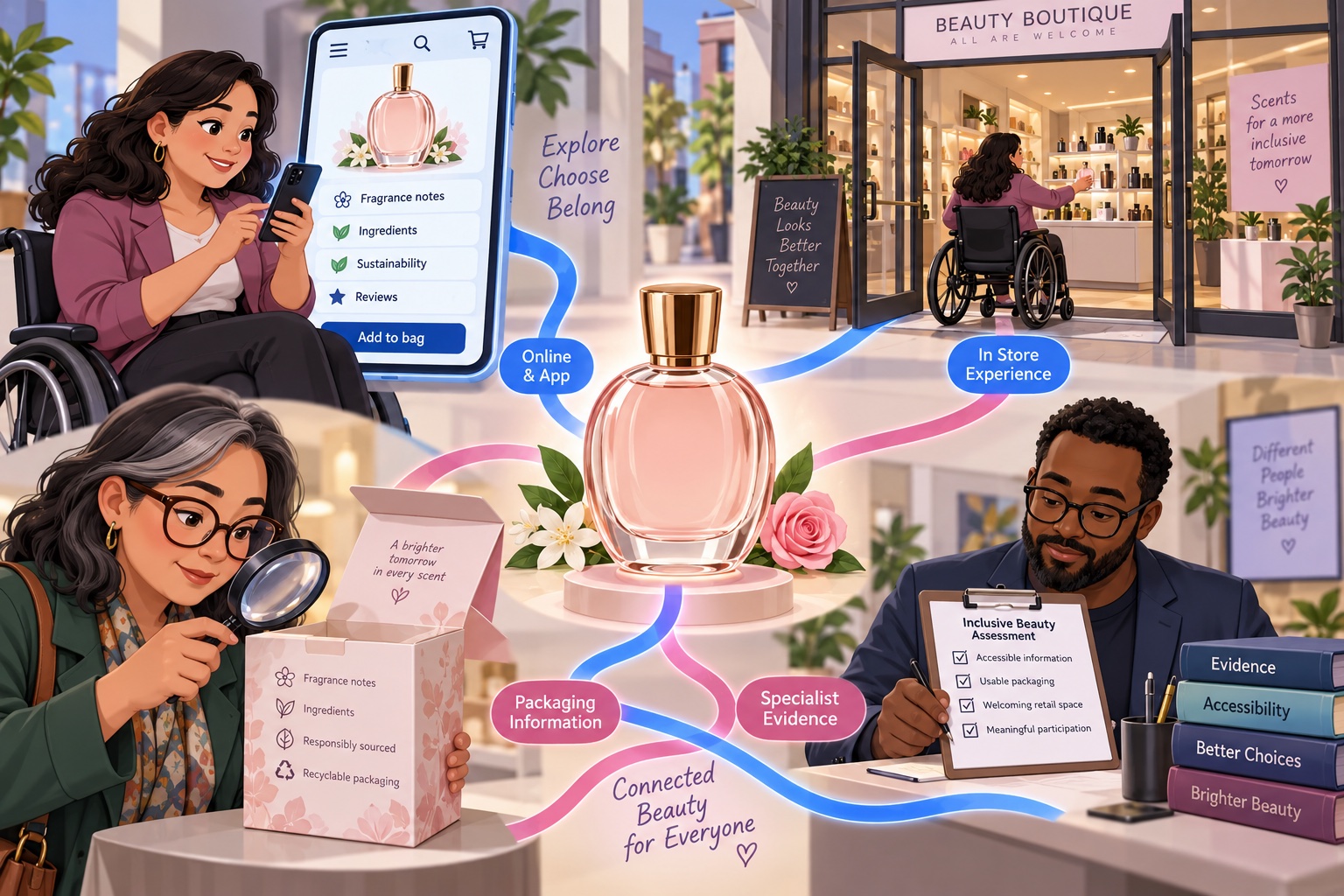
Can people obtain the information and cues needed for the task? Examples include readable product information, alternatives to visual-only cues and accessible digital descriptions.
Can people carry out the agreed actions? Depending on scope, examine digital controls, access to sampling and assistance, or opening and dispensing a product.
Can people make sense of choices, explanations and instructions, including what to do when an action does not go as intended?
Digital checks examine compatibility with assistive technology. Physical checks examine whether relevant information, assistance and alternative interactions support the agreed task under documented conditions.
Inside your Ingressible Assessment
We begin with your mission, the qualities you want to preserve and what customers should be able to do, understand and feel. You can bring questions or concerns, or we help establish the goals without assuming something is wrong. Together, we agree which services, products, locations and customer tasks to assess. Your findings connect the observed barrier to its effect on the experience and a practical next step.
We examine the real tasks around fragrance and makeup: identifying a product, comparing shades or scents, exploring a tester, opening packaging and controlling an applicator.
Four services explore websites and apps, retail experiences including agreed mystery shopping, and fragrance and makeup products. Choose the relevant work rather than treating every touchpoint as an isolated problem.
We discuss the qualities you want to preserve, then recommend proportionate changes. Workshops and working sessions can help your team understand the findings and decide what to do next.
You receive documented observations, testing limits, priorities and practical recommendations. Agreed rechecks show what changed. Founder-led assessment is described honestly; it is not presented as a recruited customer panel.
Can the person find the intended item?
Can they understand and compare their options?
Can they open, control and use it?
What gives them confidence to come back?
We can agree measures such as task completion, requests for help, successful product use, repeat purchases and contribution after costs. A lifetime customer has no universal price tag; their value depends on your actual purchase and cost data.
An invitation to look closer
Your vision starts the conversation. Together, we can investigate the experience around it, with care, evidence and room for imagination.
Start a conversationThe right to access. The capability to participate. The opportunity to belong.